
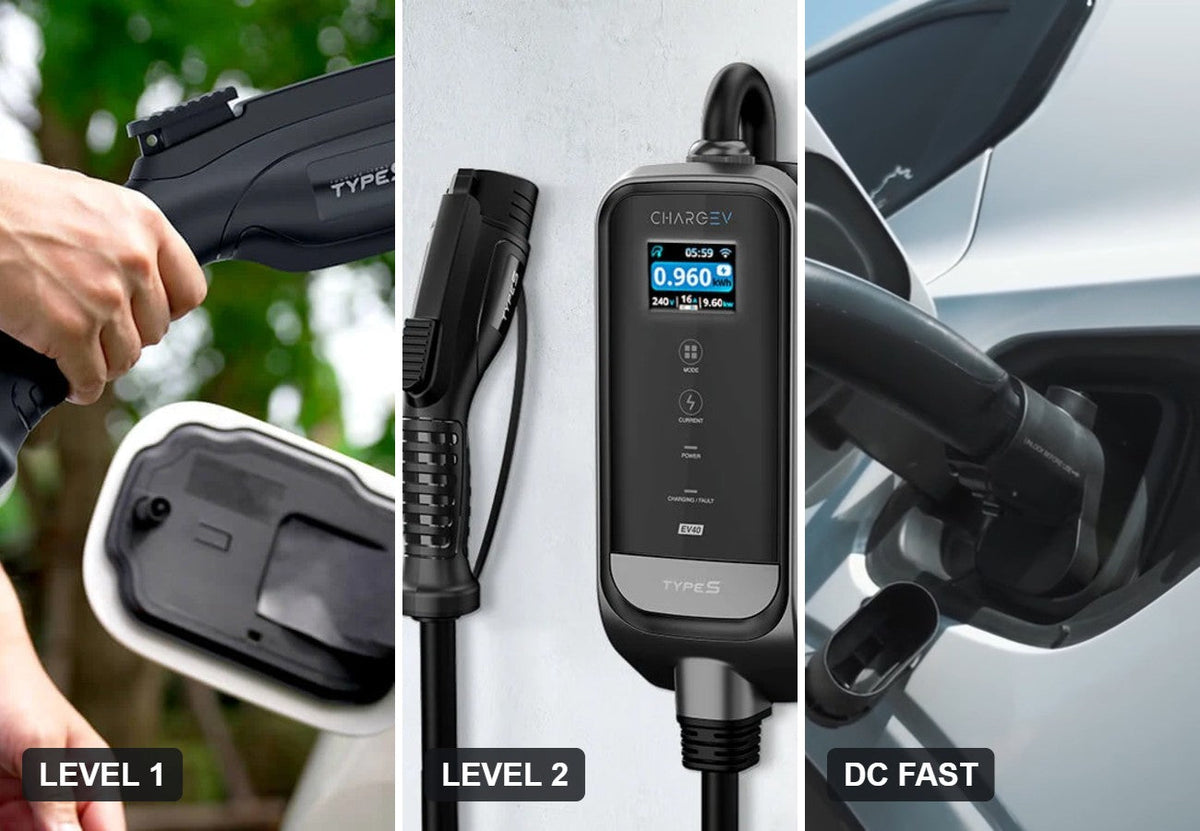
If you’re shopping for an EV or a home charger, you’ll hear about Level 1, Level 2, and Level 3 charging. The levels describe how much power a charger delivers, which decides how fast your battery fills up. Here’s what each level means, how fast it really is, and which one makes sense for your home.

Level 1 vs Level 2 vs Level 3 Charging at a Glance
| Level 1 | Level 2 | Level 3 (DC fast) | |
|---|---|---|---|
| Power source | 120V AC (standard outlet) | 208V or 240V AC | DC, from commercial power |
| Typical power | About 1.9 kW | 2.9 to 19.2 kW | Up to 500 kW |
| Range added | About 5 miles per hour | About 25 miles per hour | About 100 to 200+ miles in 30 minutes |
| Where you’ll find it | Home | Home, work, and public lots | Highway and public fast-charging stations |
| Best for | Short commutes and plug-in hybrids | Everyday charging for most drivers | Road trips and quick top-ups |
Range figures are typical estimates from the U.S. Department of Energy. Your actual speed depends on your vehicle, its battery, and the charger.
What Is Level 1 Charging?
Level 1 charging uses a regular 120-volt household outlet, the same one you’d plug a lamp into. Most EVs come with a portable Level 1 cord, so you can start charging without installing anything.
- Speed: About 5 miles of range per hour of charging, based on 1.9 kW of power.
- Overnight: About 8 hours of charging adds roughly 40 miles of range to a mid-size EV.
- Best for: Drivers with short daily commutes, plug-in hybrids, and anyone who only has a 120V outlet.
The TYPE S CHARGEEV 16A Level 1 Charger plugs into a standard outlet with its NEMA 5-15 adapter and lets you choose 6, 10, 13, or 16 amps. It also includes a NEMA 10-30 adapter, so you can plug into a 240V outlet for faster charging when one is available.

What Is Level 2 Charging?
Level 2 charging runs on 240 volts at home (or 208 volts at many businesses), the same kind of circuit an electric dryer uses. It’s the most popular way to charge at home, and most public chargers in the U.S. are Level 2.
- Speed: About 25 miles of range per hour, with power ranging from 2.9 to 19.2 kW depending on the charger and circuit.
- Overnight: Enough to fully charge a typical EV battery.
- Electrical needs: Level 2 needs a dedicated 240V circuit. A common 30-amp home charger (7.2 kW) needs a 40-amp circuit.
The TYPE S CHARGEEV 40A Level 2 Charger delivers up to 9.6 kW, plugs into a NEMA 14-50 outlet, and lets you schedule and monitor charging from the TYPE S mobile app. TYPE S recommends a 50-amp circuit and professional installation.

What Is Level 3 Charging (DC Fast Charging)?
“Level 3” is the common name for DC fast charging. Instead of using your car’s onboard charger, a DC fast charger sends direct current straight to the battery, so it’s much faster.
- Speed: About 100 to 200+ miles of range in 30 minutes, with chargers delivering up to 500 kW.
- Where: Public fast-charging stations along highways and busy routes. DC fast chargers need commercial power, so they aren’t practical for most homes.
- It slows down as you fill up: Charging is fastest when the battery is low and tapers as it gets full.
- Your car sets the limit: Many EVs can’t accept more than about 200 kW, even at a faster charger.
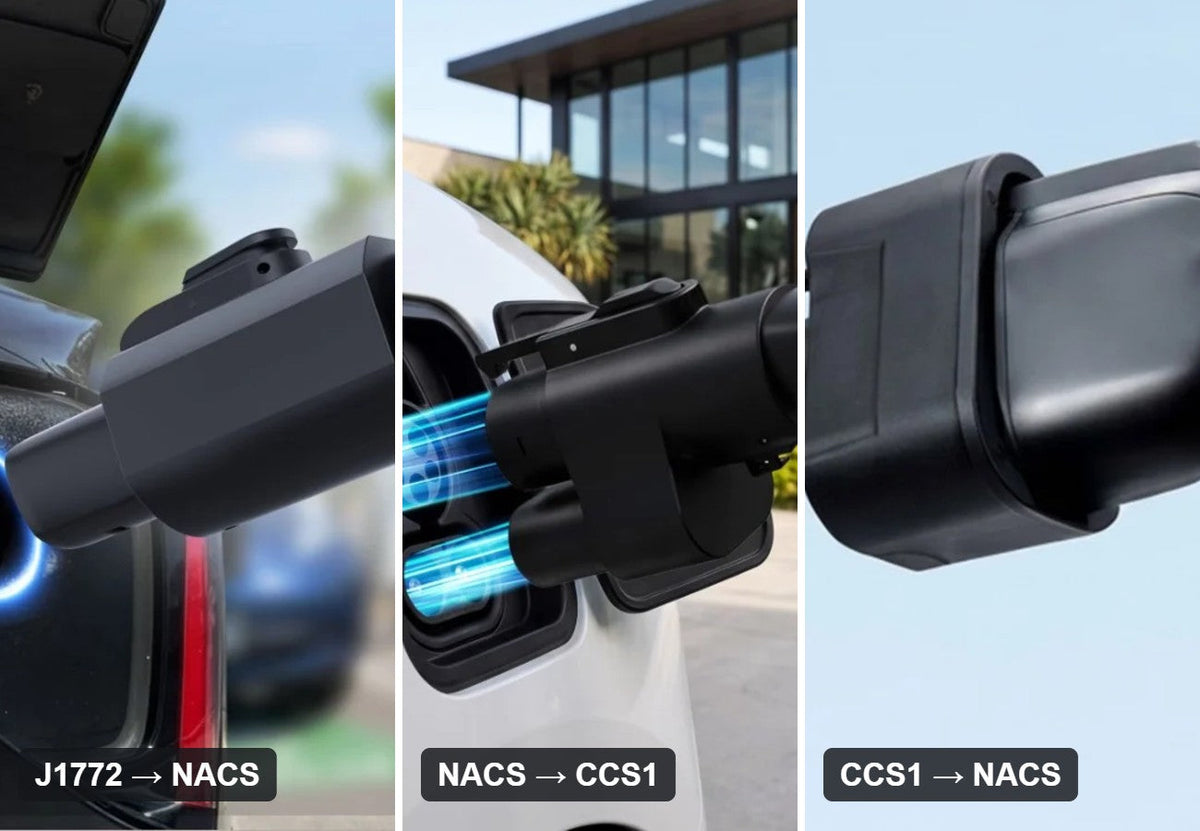
DC fast chargers in North America use CCS1, NACS, or CHAdeMO connectors. TYPE S ChargEV adapters let compatible EVs use more of them, like the NACS to CCS1 adapter for supported Tesla Superchargers and the CCS1 to NACS adapter for Teslas at CCS1 stations.

How Long Does It Take to Charge an EV?
There’s no single answer, because charging time depends on:
- Battery size – Bigger batteries take longer to fill.
- State of charge – Charging from 10% takes longer than topping off from 60%.
- Your car’s onboard charger – For Level 1 and Level 2, your car can only accept so much AC power. A 9.6 kW charger won’t charge faster than your car allows.
- The charger’s power output – And for Level 2, the circuit it’s connected to.
As a rule of thumb, Level 1 adds a few miles per hour, Level 2 refills most EVs overnight, and DC fast charging adds hundreds of miles in under an hour.
Which Charging Level Do You Need at Home?
- Choose Level 1 if you drive under about 30 to 40 miles a day, have a plug-in hybrid, or can’t add a 240V circuit.
- Choose Level 2 if you drive more each day, have a larger battery, or want a full charge every morning.
- Use DC fast charging for road trips. Many automakers recommend Level 2 for everyday charging and saving fast charging for when you need it, so check your owner’s manual.
Not sure which plug your car uses? Read EV Charging Connector Types Explained.
Installing a Level 2 Charger: What to Know
- Hire a licensed electrician – They can confirm your panel has room for a dedicated 240V circuit and install it to code.
- Match the circuit to the charger – The circuit must be sized for the charger’s current. For example, a 30-amp charger needs a 40-amp circuit, and TYPE S recommends a 50-amp circuit for its 40A charger.
- Check permits – Requirements vary by city and county.
- Keep the cable tidy – A wall dock like the TYPE S ChargEV EV Charger Dock keeps the connector off the ground and locks it in place.
EV Charging Levels FAQ
Is Level 3 charging the same as DC fast charging?
Yes. “Level 3” is the everyday name for DC fast charging.
How many miles does Level 1 charging add per hour?
About 5 miles of range per hour, or roughly 40 miles over 8 hours, according to the U.S. Department of Energy.
How fast is Level 2 charging?
About 25 miles of range per hour on average. The exact speed depends on the charger’s power (2.9 to 19.2 kW) and what your car can accept.
Can I install a Level 3 charger at home?
Generally no. DC fast chargers are designed for commercial power and are very expensive, so home charging is Level 1 or Level 2.
Can a Tesla use a Level 2 J1772 charger?
Yes. Teslas can use J1772 Level 2 chargers with a J1772 to NACS adapter, such as the TYPE S ChargEV J1772 to NACS adapter.
Is Level 2 charging better than Level 1?
Level 2 is about five times faster, which makes it the better fit for most daily drivers. Level 1 is still a good, low-cost option for short commutes.
Conclusion
Level 1 is the simplest way to charge, Level 2 is the sweet spot for home charging, and Level 3 (DC fast charging) is for road trips. If you’re ready to charge at home, compare the CHARGEEV 16A Level 1 and CHARGEEV 40A Level 2 chargers.


Leave a comment
This site is protected by hCaptcha and the hCaptcha Privacy Policy and Terms of Service apply.